 Search
 Contact
Advanced brain imaging reveals promise of new Parkinson’s disease treatment
Thursday, 4th December 2025
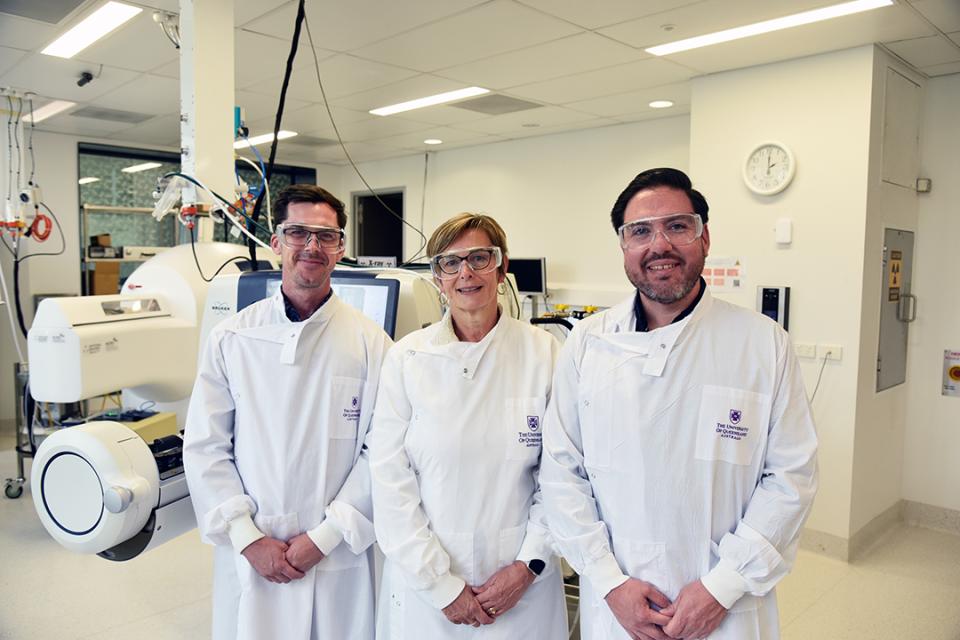
Professor Trent Woodruff, Associate Professor Karine Mardon and Dr Eduardo Albornoz Balmaceda.
News published by University of Queensland reveals researchers have developed a promising new anti-inflammatory drug and, for the first time, used advanced imaging to watch its effects unfold inside the living brain, a breakthrough that could accelerate treatments for Parkinson’s disease.
Senior author, Professor Trent Woodruff, Group Leader of UQ’s Neuroinflammation Lab said it was a huge step forward in the search for a treatment for Parkinson’s Disease.
“Parkinson’s is one of the fastest growing neurodegenerative diseases, and it is expected to impact more than 25 million people by 2050,” Professor Woodruff said.
“Current therapies can alleviate symptoms but do not significantly slow or stop progression of the disease.
“This new class of drugs aims to do exactly that, and by combining it with cutting-edge PET/MRI biomarkers, we can measure whether it’s truly protecting the brain.”
Lead author Dr Eduardo Albornoz Balmaceda from the School of Biomedical Sciences said testing in mice models showed the new-generation oral drug blocked inflammation in the brain and helped improve motor function.
“Inflammation acts like a slow-burning fire in the brain, progressively damaging the neurons that produce dopamine – the chemical which controls movement,” Dr Albornoz Balmaceda said.
“Our study showed this drug, which targets part of the immune system called ‘inflammasomes’, reduced brain inflammation and prevented the disease from killing more neurons, therefore stopping its progression.
“What’s most exciting is we could actually see these changes happening in the living brain using advanced simultaneous positron emission tomography (PET) and magnetic resonance imaging (MRI), performed within UQ’s Centre for Advanced Imaging.
“This imaging approach gives us a safe and powerful tool to track target engagement and disease progression, which is essential for designing future human clinical trials.”
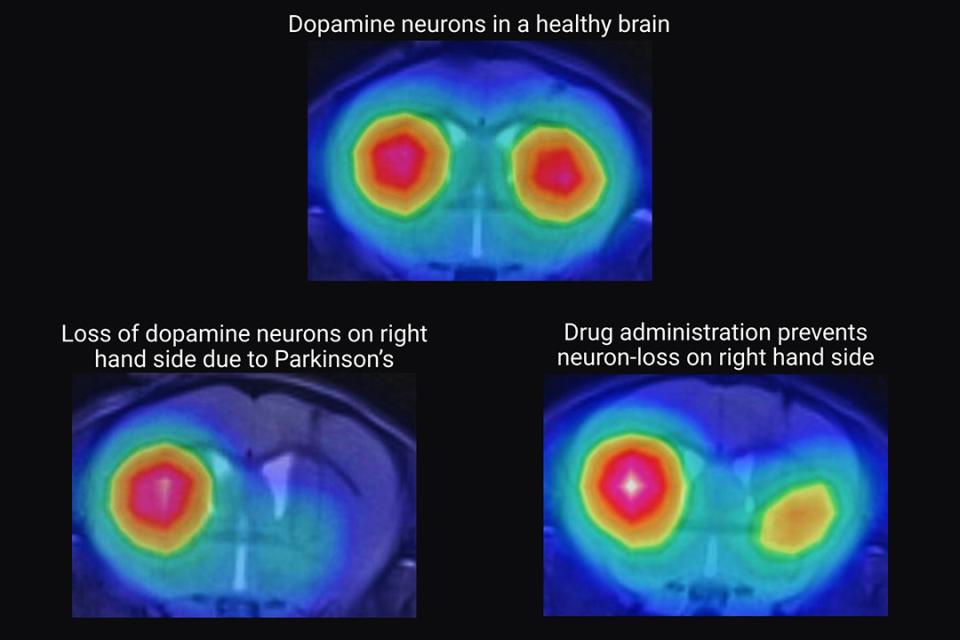
Brain scans show a loss of dopamine-containing neurons in the brain caused by Parkinson’s disease, but these signals improved with the drug.
The research was supported by NHMRC, Inflazome, The Michael J Fox Foundation and Shake it Up Australia Foundation.
Shake It Up Australia was proud to have supported this ground-breaking project along with our partners at The Michael J. Fox Foundation.
The research is published in Brain.