Search
 Contact
Hannah Runs for Research in her 3rd Race for Team Shake It Up
Monday, 3rd August 2026
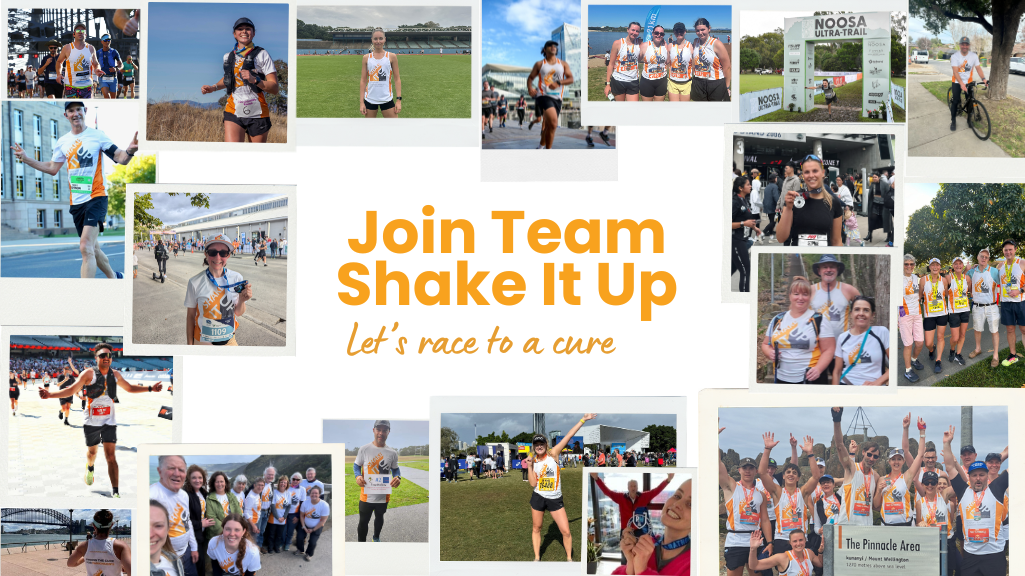
Team Shake It Up is our inspiring group of fundraisers who take part in athletic events to raise funds for Parkinson’s research, racing towards a cure. From fun runs to marathons and endurance events, there are so many ways that people can get active to help us accelerate research to slow, stop and cure Parkinson’s.
One of our fundraisers, Hannah, is now in her third race in support of Shake It Up, and is passionate about making a difference in support of her Dad, who lives with Parkinson’s. The upcoming Sydney Marathon will be Hannah’s first full marathon.
“My dad remains active, he still runs and cycles, and seeing him continue to do the things he loves motivates me to stay active too”, Hannah told us. “At the same time, I know not everyone with Parkinson’s is in that position. The possibility that he may not always be able to do those things is one of the reasons research is so important to me. Taking on my first marathon is a personal challenge, but supporting a cause so close to my heart makes the journey even more meaningful.”
We spoke with Hannah all about her running journey, why she’s a proud member of Team Shake It Up and her upcoming marathon.
Hi Hannah! What inspired you to take on the Sydney Marathon?
I feel like I just fell into running, really. A friend invited me to my first parkrun in 2024, and I couldn’t run the entire 5km, but I kept going back and making little bits of progress. I really enjoyed proving to myself what I was capable of, and each challenge naturally led to the next. Next, I signed up for City2Surf (and had so much fun), then challenged myself with my first half marathon, so a full marathon felt like the obvious next challenge. When I registered for City2Surf, and again now for the Sydney Marathon, the fundraising opportunity immediately made me want to support something meaningful to me.
My dad was diagnosed with Parkinson’s a few years ago, so supporting Parkinson’s research felt like a natural choice. That’s when I found Shake It Up Australia. I was particularly drawn to the transparency of their work. Seeing the specific research projects they support and knowing that donations directly contribute to Australian Parkinson’s research made me feel confident this was a cause I wanted to support.
Since my Dad’s diagnosis, I have experienced Parkinson’s from both a personal and professional perspective. Through my nursing placements and now working as a nurse, I have seen the impact that neurological conditions can have on individuals and their families, which has given me an even greater appreciation for the importance of research and improving outcomes for people living with these conditions.
-

- Hannah and her Dad
-
- Hannah Completing the Canberra Times Fun Run
-

- Hannah Completing the City2Surf
How is the training going for your first ever marathon?
If you asked my mum, she would tell you I always hated running. The only running I ever did was on the hockey field, never running just for the sake of running. Taking on a marathon is a huge physical challenge for me and definitely something outside my comfort zone. Training has been a learning experience, especially while working as a new graduate nurse. Balancing shift work, night shifts, and finding time to run has been challenging, particularly through the Canberra winter. I’ve also had to learn how to balance training with other commitments, like playing hockey on the weekends, and making sure I give my body enough time to recover.
There have definitely been moments of doubt. When I first attempted a half marathon, I learned some hard lessons about pacing and hydration, so ensuring I don’t repeat those mistakes has been both a physical and mental challenge during my training. There is also a different kind of pressure when you’ve told people you’re doing something like this, and everyone is waiting to see you achieve it. My main goal for this marathon is simply to finish. When I attempted my first half marathon, I put pressure on myself to achieve a certain time, and I learned that long-distance running is about much more than just the finish time. As this is my first marathon, I want to enjoy the experience, take it all in, and hopefully use it as a stepping stone for future challenges.
One of the most rewarding parts of training has been seeing how much I’ve progressed. Running 20 km in training was a huge moment for me because when I first completed a half marathon, the 21km distance felt like such a major achievement. To then reach a point where I could run 20 km as part of a normal training run was a reminder of how far I’ve come. Every run I finish makes me feel a little closer and a little more prepared, and I’ve surprised myself with what I’ve achieved so far.
Thinking about race day, what are you most excited about?
I think there will definitely be some nerves leading into race day, especially the night before and the morning of, but what I’m most excited about is experiencing the atmosphere and finally reaching the finish line. One of the things I’ve loved about running is the community that comes with it. I’ve experienced that community through parkrun, City2Surf, and local half marathons in Canberra. There is such a supportive community of people all working towards their own goals and challenges. For the Sydney Marathon, knowing that thousands of other people will also be running for their own personal reasons will be really special. This will be especially meaningful considering everyone’s support and generosity toward the fundraising.
Running across the Sydney Harbour Bridge will also be an incredible moment. It’s something I’ve seen many times, but it holds such significance as an Australian icon, and being able to experience it as part of my first marathon will be something I’ll remember. I think the toughest part will probably be those final kilometres when my body is tired and the distance starts to catch up. I’m hoping that in those moments I can think about why I signed up in the first place, the reason behind the fundraising, and everyone who has supported me along the way.
Our mission is to slow, stop and cure Parkinson’s. What would that mean to you?
For me, it means giving people more time to continue doing the things they love and maintaining their independence. My dad has always been an incredibly active person, and seeing him still run, cycle and stay active despite his diagnosis is something I’m really grateful for. At the same time, it makes me aware of how important research is in helping people maintain that quality of life for as long as possible.
I also know that Parkinson’s looks different for everyone. There are people diagnosed much younger who face a very different journey, and reading some of their stories has highlighted how much more there is to Parkinson’s than what many people realise. A cure would mean that future generations may not have to experience Parkinson’s at all. It would mean fewer families having to navigate the uncertainty and challenges that come with a diagnosis.
Having seen Parkinson’s from both a personal and professional perspective, one of the biggest things I hope for is greater awareness. Many people don’t understand the full impact of Parkinson’s until they have a personal connection to it, and I hope that by sharing my experience, I can help people better understand the realities of Parkinson’s and why research, support and awareness are so important.
Do you have any advice for someone else wanting to make a difference?
I think the first step is simply to start. Making a difference doesn’t always have to mean taking on a huge challenge or raising a large amount of money. Sometimes it starts with learning more about a cause, educating yourself, and having conversations that help raise awareness.
For Parkinson’s specifically, I think one of the most important things people can do is understand that it is much more than a tremor (and some people don’t actually have a tremor). Every person’s experience is different, and increasing awareness helps create better understanding and support for people living with Parkinson’s. This is something I think is particularly important in healthcare. For my nursing colleagues, understanding Parkinson’s and its impact means we can provide more individualised care and ensure someone’s Parkinson’s diagnosis does not define their healthcare experience.
If I could go back to myself before my first parkrun, I probably wouldn’t believe where running would take me. My family probably wouldn’t either. I started with something small and simply enjoyed seeing my progress, and it has grown. I think that’s a reminder that you don’t have to know exactly where you’re going to make a start.